
How to Check a Painting Contractor’s License and Insurance in California
Earlier this year we quoted a stucco repaint in Oceanside at $4,500. The client called to say they were going with us — and offered to tell me why. Another company had bid $3,500. I asked the obvious question: why pay a thousand dollars more?
His answer: “Because they didn’t have a license.”
He’d worked out something most homeowners never think about. An unlicensed contractor isn’t just cheaper — the risk moves onto you. I’m Victor Ross, owner of Ross Painting Group (CA Lic #1151078). Here’s exactly how to verify a painting contractor before you sign, and what the paperwork actually means.
1. Look Up the License Number Yourself
Don’t take a number off a business card and assume it’s real. Every California contractor license is public — you can search by license number, business name, or personal name on the Contractors State License Board website. It takes about a minute.
Three things to confirm on that page:
- Status is “Active.” Not expired, not suspended.
- The classification is C-33. That’s the CSLB classification for Painting and Decorating. A contractor licensed only for something else isn’t licensed for your paint job.
- The name matches the company that’s actually going to do the work and sign your contract.
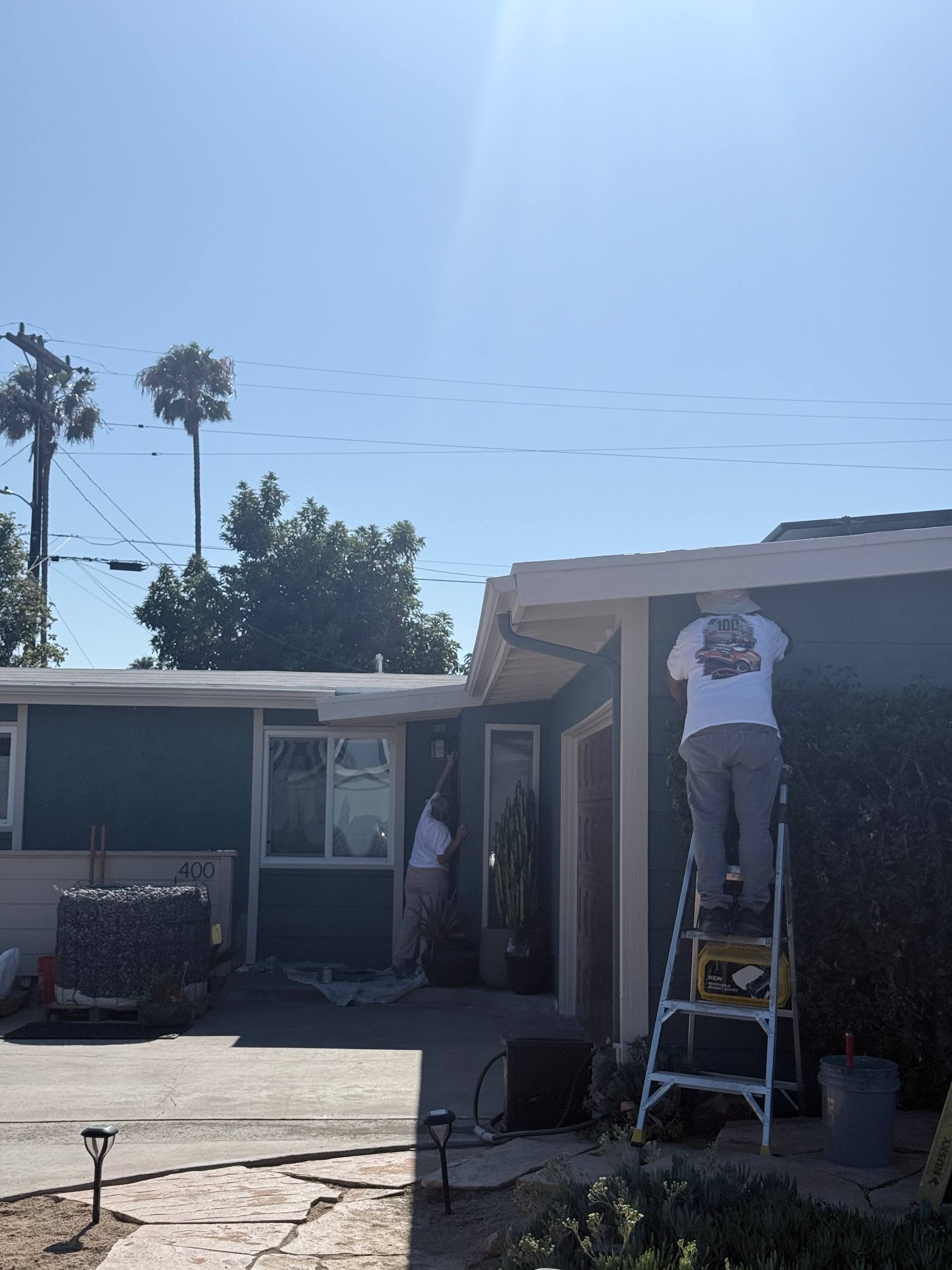
Ladder work on a San Diego exterior — the kind of job where workers’ comp coverage matters
2. Check the Workers’ Comp Line — Not Just the License
This is the part almost nobody knows, and it’s where that Oceanside client was right to be careful.
If a California contractor has employees, they’re required to carry workers’ compensation insurance and file proof of it with CSLB. But a contractor with no employees can instead file a signed exemption stating they don’t employ anyone. For some trades — concrete, HVAC, asbestos abatement, roofing, tree service — coverage is mandatory either way. Painting is not one of those trades. A painting contractor can hold a perfectly valid license with a no-employee exemption on file.
So here’s the red flag to look for: a contractor whose CSLB record shows a workers’ compensation exemption, who then shows up at your house with a crew. Those people are working on your property without coverage. If someone falls off a ladder, that’s not a hypothetical — the liability can land on the homeowner who hired them, and the bill for a serious injury runs into the tens or hundreds of thousands.
As my client put it: maybe that company did 500 jobs and nothing ever happened. But it only has to happen once, and it might as well be yours. Saving a thousand dollars isn’t worth carrying that risk yourself.
3. Ask for the Certificate of Insurance Directly
The CSLB record tells you what’s on file with the state. The certificate tells you what’s in force today. Any legitimate contractor can email you a current certificate of insurance — general liability and workers’ comp — without hesitating. If the answer is “we’ll get that to you later,” treat that as the answer.
4. Read the Price-Change Clause Before You Sign
Read the contract carefully, including the small print. The specific thing to look for is language saying the price may change. It’s very common, and it’s how a job that started at one number ends at another.
The pattern we hear about from clients goes like this: the crew works for a week, and then comes the conversation — “we used more material than expected, we need another fifteen hundred.” At that point the house is half-painted and you don’t have much leverage.
A quote should hold unless you add scope. On our jobs, the only time the price moves is when a client asks for something new mid-project — “the ceilings look bad next to the fresh walls, can you do those too.” Then we send a separate written change order with its own price, and it only counts if the client agrees to it.
Ask whether primer is included and which products will be used. “Two coats of paint” and “primer plus two coats” are different jobs at different prices, and if the contract doesn’t say, you have no way to compare two bids honestly — or to hold anyone to it later.
5. Pay Attention to the Estimator
The estimator is your first contact with the company, and in my experience it tells you most of what you need to know. Watch what they do during the walkthrough. Are they pushing add-ons you didn’t ask about? Or are they looking for ways to get you a better result inside your budget?
There are real ways to save. On a rental, painting everything one color in one sheen — walls, ceilings, trim — is meaningfully cheaper than a multi-color job, and for a rental it’s usually the right call anyway. A good estimator brings that up. A bad one doesn’t, because it lowers the invoice.
As a rule: if the estimator is sloppy, the company is sloppy. That’s where “we calculated it wrong, you need to pay more” comes from. It starts at the estimate.
Want a Quote You Can Actually Compare?
License #1151078, insured, written scope, no surprise line items. Free estimate anywhere in San Diego, Orange County, or Los Angeles.
What About Subcontractors?
We do use subcontractors, and I’ll be straightforward about how that works, because “do you subcontract?” is a question people ask nervously.
Every sub we use is a former Ross Painting Group employee who went and got their own license and started their own company. They learned the work here. In practice it’s still one team — there’s nobody on your property I don’t personally know. That’s the whole rule: I only work with people I know.

The crew — the same people, job after job
How Long Should the Warranty Be?
We give two years. You’ll see companies offering anywhere from one year to five, and a longer number looks better on paper — so it’s worth understanding what a warranty actually catches.
Our work generally holds for five to seven years, and often ten. But defects, when they happen, show up almost immediately — bad prep, wrong primer, a product that shouldn’t have gone on that surface. Those surface within the first season, not in year four. A two-year window covers the real failure mode honestly. I’d rather commit to something I’ll actually stand behind than advertise five years and start arguing about what’s covered.
Getting a Second Opinion Is Not Rude
One more thing worth saying plainly. We’ve been called in to redo work another contractor did badly, and the redo ran several times the original quote. That’s the usual shape of it: stripping failed paint, fixing what was covered up instead of repaired, and starting over is always harder than doing it right once.
If a bid feels off, get another one. Any contractor confident in their work will tell you the same.
Once you’ve got two or three bids in hand, our guide to why painting quotes differ so much walks through how to compare them line by line — including the full list of questions to ask before you choose. For what the work itself should cost, see our exterior painting cost guide and interior painting cost guide.
Frequently Asked Questions
Search the contractor on the Contractors State License Board website at cslb.ca.gov by license number, business name, or personal name. Confirm three things: the status reads “Active,” the classification includes C-33 (Painting and Decorating), and the business name matches the company signing your contract.
No. California requires licensees with employees to carry workers’ compensation and file proof with CSLB, but a contractor with no employees can file a signed exemption instead. Certain trades — concrete, HVAC, asbestos abatement, roofing and tree service — must carry it regardless, but painting is not one of them. Check the workers’ compensation line on the CSLB record, not just the license status, and be cautious if a contractor with an exemption on file arrives with a crew.
Without workers’ compensation coverage in place, the financial responsibility for an on-site injury can fall to the homeowner who hired them. Depending on the injury, that exposure runs into the tens or hundreds of thousands of dollars — which is why saving one or two thousand on the bid is rarely worth it.
Only if your contract allows it — which is why you should read the price-change language before signing. A quote should hold unless you add scope yourself. At Ross Painting Group, the price changes only when a client requests additional work mid-project, and then only through a separate written change order the client approves.
We warranty our work for two years. Companies advertise anywhere from one to five years, but genuine defects — bad prep, the wrong primer, an unsuitable product — appear within the first season rather than years later. Our work typically holds five to seven years and often longer; the two-year warranty covers the window where real problems actually surface.
Ready to Get Started?
Free estimate, no obligation. We respond within 10 minutes.