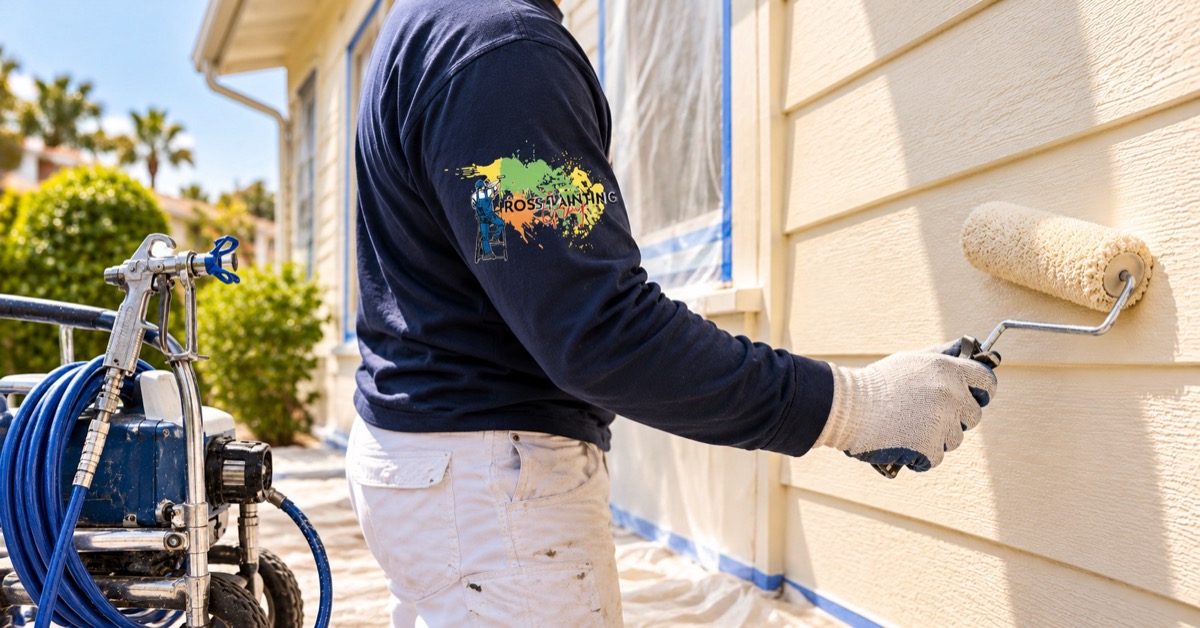
AI-generated editorial illustration; not a photograph of a completed Ross project.
Spray vs. Roll for Exterior Painting: When Does Your Home Need Back-Rolling?
One painter says they spray. Another says they roll. Which estimate is better? The useful answer starts with your home’s surfaces, not the equipment. Older textured siding, smoother siding and detailed trim can call for different methods on the same property.
For a San Diego exterior repaint, ask the estimator to explain the preparation and application plan for each surface. “We always spray” or “we always roll” leaves out the part that matters: why that approach fits your home.
What does back-rolling mean?
Back-rolling means following spray application with a roller while the coating is still wet. It is not simply coming back later to add another coat. Whether it belongs in the job depends on the surface and the selected coating system.
Manufacturer guidance is also specific to the material. For example, Sherwin-Williams describes back-rolling when applying certain elastomeric coatings over rough stucco. That does not mean every Ross repaint uses an elastomeric coating, or that every surface needs the same treatment. The product data sheet and the actual surface should guide the method.
Older siding: one approach Victor described
In his account of inspecting an older siding repaint, Victor described loose paint and weathered wood that required preparation before the finish coats. His proposed sequence included cleaning, scraping and sanding, then spot priming where needed.
For that particular surface, he described spraying the first finish coat and immediately back-rolling it. After the appropriate drying interval, the second finish coat would be sprayed. This was a plan for a particular condition—not a rule that every coat on every house must be rolled.
A photograph alone may not reveal how much old paint is loose or how much repair is needed. That is why the inspection should establish the preparation before the application method becomes the headline.
Why a smoother surface may need a different method
Victor also gave the opposite example: smooth, newer siding may not need back-rolling. Detailed trim, fascia and eaves can have a different application plan from the main walls. It is reasonable for one estimate to specify different methods for different parts of the house.
That is not automatically a shortcut. What needs explaining is the relationship between the existing surface, the coating and the intended finish. If the proposal changes from spray-and-back-roll to spray only, ask which surface condition supports that decision.
Does spraying automatically mean a thin or inferior finish?
The tool alone does not establish the quality of the job. Review the preparation, product, included surfaces and application requirements together. A quote that names an application method but says little about failing paint or repairs is not detailed enough to compare confidently.
Likewise, back-rolling should not be sold as a guarantee of a fixed number of extra years. Ask what the selected method is intended to achieve on your surfaces, rather than relying on a promise that one technique makes every coating last twice as long.
Five questions to ask when comparing estimates
- Which surfaces are included? Separate the main walls, siding, trim, doors and other agreed components.
- What preparation is included? Ask about loose coatings, local repairs and areas requiring primer.
- Where will the crew spray, roll or brush? The explanation should match the surfaces, not just a preferred tool.
- Which coats receive which treatment? Do not assume that “back-roll” means all finish coats, or that primer counts as a finish coat.
- What must be protected and kept accessible? Discuss nearby belongings, plants, access and the areas the crew will work in.
Choose the scope before choosing the lowest number
Two estimates can describe “exterior painting” while including different repairs and surfaces. Use our guide to comparing painting estimates to organise those differences. If you are budgeting the full project, the separate exterior painting cost guide covers that decision; this article is about the application plan.
Planning a repaint? Start with our exterior painting service, then request an estimate. Tell us which surfaces concern you and ask the estimator to explain where back-rolling is—or is not—part of your written scope.
Ready to Get Started?
Free estimate, no obligation. We respond within 10 minutes.